
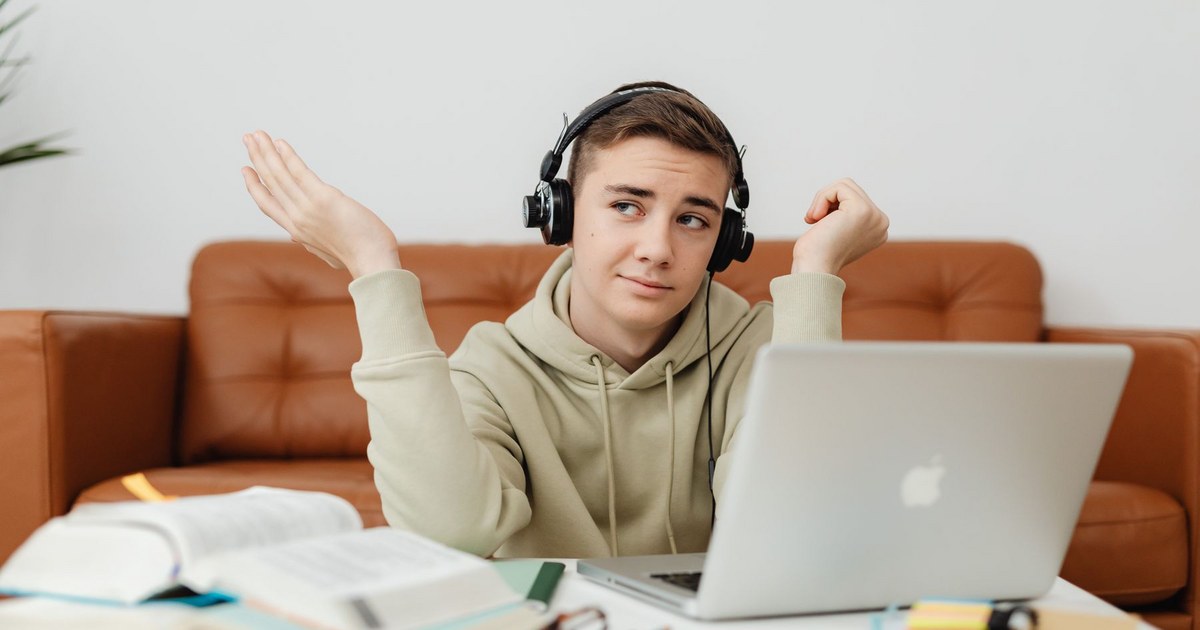
You don't need to move abroad to make fast progress in English. The students who improve fastest share the same concrete habits — and the most underrated one costs nothing: speaking English out loud, alone, at home.
01 — The principle
Immersion doesn't require a plane ticket
Full immersion in an English-speaking country remains the fastest method — but most of its effectiveness comes from one reproducible mechanism: a brain that no longer has a choice but to process English continuously, several hours a day, progresses faster than one that only encounters it once a week in class.
A foreign student can artificially recreate that pressure at home, without spending a cent more than what they already pay for an internet connection.
02 — The most powerful strategy
Speaking English alone, even with no one listening
It's the most underused strategy, and yet one of the best documented: a 2022 study published in Language Learning & Technology found that learners practicing structured self-talk (speaking alone, recording themselves) improved their oral fluency at a rate comparable to those receiving direct human feedback.
The principle is simple to apply, even in a bedroom, even with no one to talk to:
- Narrate out loud what you're doing as you do it — making a meal, tidying your room, getting dressed in the morning.
- Recap your day every evening, out loud, as if telling it to a friend.
- Debate yourself on a topic with two sides — argue each position out loud, in turn.
- Record yourself for one minute a day and listen back a week later: the progress is audible.
03 — Building the environment
Creating daily English pressure
Switch your phone, social media, and subtitles to English; listen to podcasts during commutes instead of music in your native language; join an online language exchange group (like Polyglot Club) to practice with real English speakers without leaving your room.
Avoid, as much as possible, spending all your time with people who share your native language: every exchange in English, even a short one, counts for more than an hour of passive class time.
04 — Consistency over intensity
20 minutes a day beats 3 hours on Sunday
Short, regular daily practice cements language better than long, spaced-out sessions — the brain consolidates learning spread over time far better than learning crammed into a single session.
05 — FAQ
Frequently asked questions
Isn't it awkward to talk to yourself in English?
A bit at first, but that's exactly what makes it powerful: no possible judgment, so no fear of making mistakes — the number one barrier to speaking up in the first place.
How long before you see progress?
With 15 to 20 minutes of daily practice, most learners notice a real difference in oral fluency within four to six weeks.
Do you need a minimum level to start self-talk?
No — even with limited vocabulary, describing what you see or do in simple words already builds the automaticity of spoken production.
06 — Sources
Sources
References
- Practice English Speaking Alone: Methods That Work
- stimuler.tech
- The Self-Talk Technique — MosaLingua
- mosalingua.com
Réagissez
Commentaires